Quick Answer — The 13 Kibbe Types
The Kibbe Body Type System (David Kibbe, 1987) distinguishes 13 style types based on the balance between Yang (angular, straight, elongated) and Yin (soft, rounded, compact). The 5 core families are: Dramatic, Natural, Classic, Gamine and Romantic — each with 1–3 subtypes. Knowing your Kibbe type shows you which cuts, silhouettes and fabrics best support your natural appearance. Online self-tests are frequently wrong — a professional analysis provides real clarity.
There is a moment in every style consultation that changes everything. A woman stands in front of the mirror, puts on a dress she noted in a Milan shop window six months ago — and immediately sees that it doesn't work for her. Not because the dress is bad. But because it was never designed for her line. This is exactly where the Kibbe Body Type System comes into effect: it shifts the question from "What's trending right now?" to "What truly suits my body?". If you have ever felt that trends make you look smaller rather than greater, this guide is for you.
What Is the Kibbe Body Type System?
David Kibbe is an American image consultant who developed a system in the late 1980s that is still considered one of the most precise tools in style consulting today. His book "Metamorphosis" (1987) was the first attempt to understand women's bodies not through flat categories like "apple" or "pear," but as a holistic energetic presence. Kibbe doesn't ask: "Where are you wide?" He asks: "What does your body radiate when you walk into a room?"
The system describes 13 types — distilled over years from countless analyses of real women. Each type is not merely a body shape, but a visual identity: proportions, bone structure, facial features, line flow and even presence all come together. That is why a professionally determined Kibbe type is so much more than "size 10, B cup." It tells you which silhouettes amplify you and which work against you.
Yin and Yang — The Heart of the System
To understand Kibbe, you need to grasp one concept: the Yin-Yang balance. Kibbe borrowed these terms from Eastern philosophy but redefined them for style consulting. Yang in his system stands for everything straight, angular, elongated, and sharp. Yin stands for everything soft, rounded, compact, and lush. Neither pole is better — they are simply different visual languages.
Almost no woman is pure Yang or pure Yin. Most bodies carry a mixture, and precisely that mixture determines your type. A woman with long bones, square shoulders and a sharp jaw — but soft curves at the waist and hips — has a different line than a woman with short bones, a round face and a straight body. Both are "curvy," but they need diametrically different clothing to express their balance.
Yin and Yang in Kibbe are not a personality description. They are geometry. They describe lines, not character.
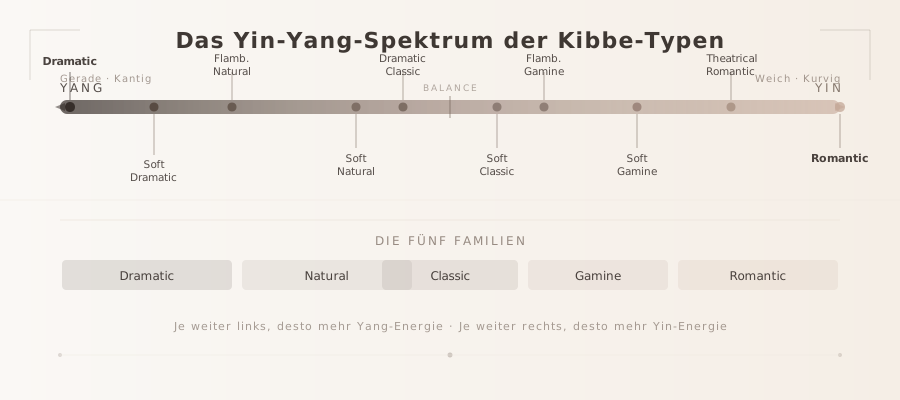
The Five Core Families
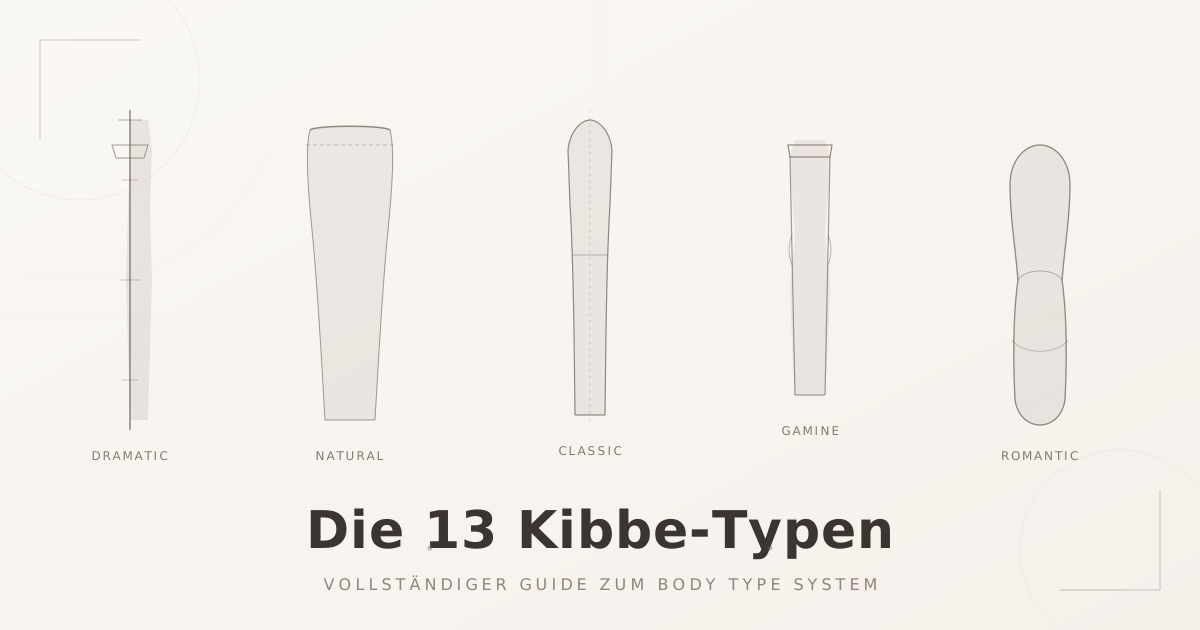
Before diving into the 13 types, it helps to know the major families. Kibbe assigns every type to one of five lines — and within each family there are variations.
- Dramatic — pure Yang. Tall, straight, sharp.
- Natural — moderate Yang. Relaxed, broad, grounded.
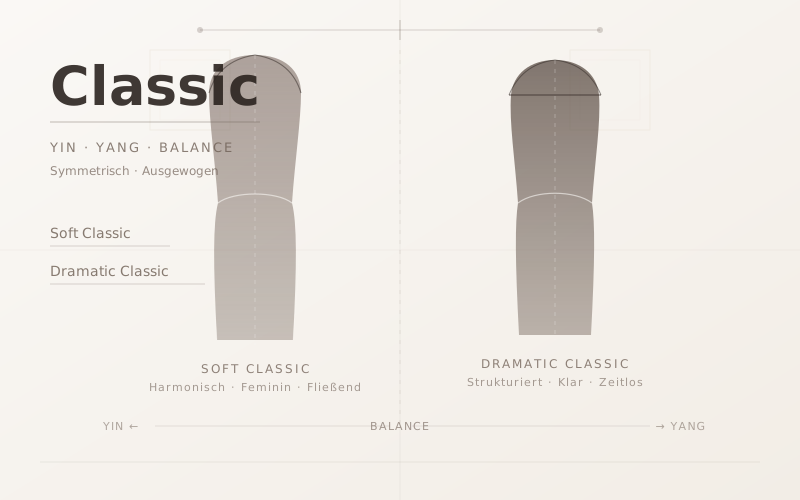
- Classic — perfect Yin-Yang balance. Symmetrical.
- Gamine — Yin-Yang contrast. Compact with angles and edges.
- Romantic — pure Yin. Compact, soft, curvy.
If someone asks: "But which direction do you lean?" — the answer is always one of these five. The 13 types are refinements, dialects within a language, so to speak.
The 13 Kibbe Types in Detail
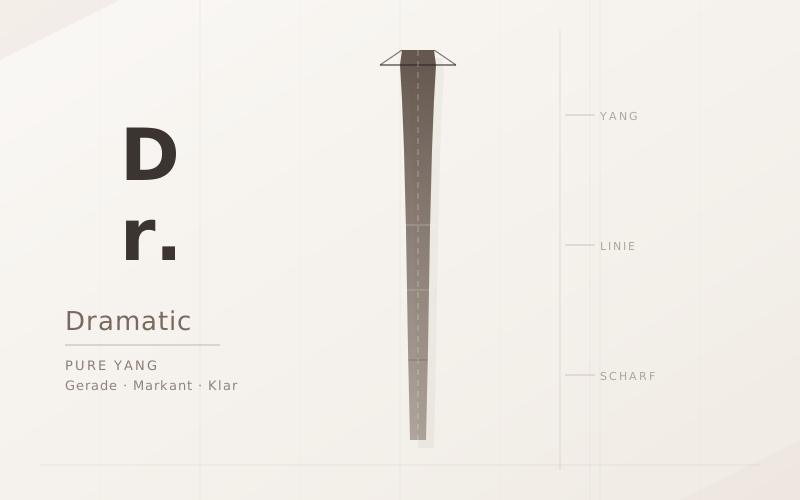
1. Dramatic
The pure Yang line. Tall (often above 5'7"), long bones, narrow shoulders with sharp edges, an elongated face with defined features. The silhouette reads as severe and powerful. Dramatics need clean, long, unbroken lines: pencil skirts, straight dresses, sharp shoulder seams. Ruffles, flounces and rounded shapes dilute their impact. Icons: Tilda Swinton, Anjelica Huston.
2. Soft Dramatic
Dramatic structure plus lush Yin elements: full bust, soft face, defined lips or eyes. The height stays tall, the lines long, but the surface is sensuous. Soft Dramatics are what Hollywood calls a "diva": long cuts with draped, flowing fabrics — silk, velvet, heavy jerseys. Icons: Sophia Loren, Ava Gardner.

3. Flamboyant Natural
The generous, relaxed Yang line. Broad, tall, open — with a hint of nonchalance. Flamboyant Naturals look as though they just stepped out of a film about ranch life: broad shoulders, lean hips, naturally tousled presence. Oversized cuts, linen, rough textures, layers are their territory. Icons: Jerry Hall, Cameron Diaz.
4. Natural
In Kibbe's current revision, this type has been removed from the system — it is now considered a sub-form rather than a standalone category. Many consultants still refer to it, however. The line: moderate Yang dominance, relaxed bones, medium height, no extreme curves. If you read older Kibbe books, you will encounter this type. Today the guidance is: you are either Flamboyant Natural or Soft Natural.
5. Soft Natural
Medium to petite, relaxed bones, but with soft curves — often a full bust and rounded hips. The face is soft, slightly dreamy, never sharp. Soft Naturals look best in flowing, unstructured fabrics with a hint of waist definition: wrap dresses, soft knit sets, corded belts. Icons: Jennifer Aniston, Drew Barrymore.
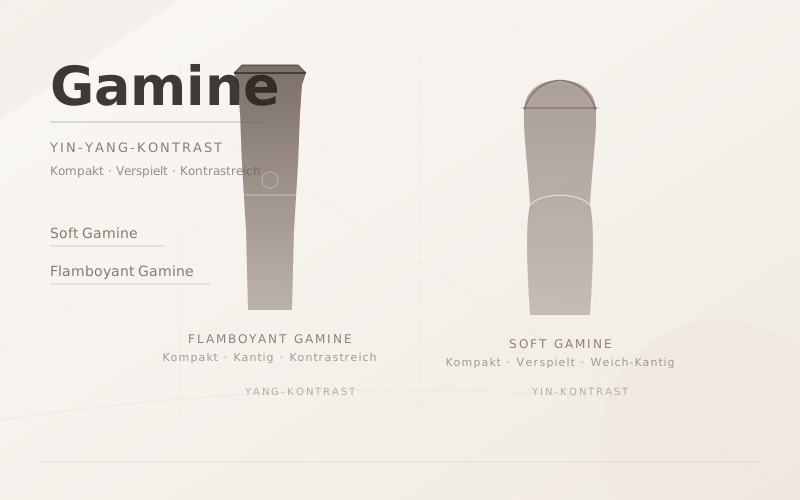
6. Flamboyant Gamine
Small and compact, but with unexpected Yang edges: sharp shoulders, angular hands, a defined face. The line constantly breaks — nothing runs smoothly through. Flamboyant Gamines need contrast, geometric patterns, accents, colour blocks. They are the queens of the "bold move": who else can pair a striped jacket with plaid trousers and look completely pulled together? Icons: Edith Piaf, Bette Davis (young).
7. Gamine
This type has also been dissolved in the new classification. Gamine once represented the middle ground between Soft and Flamboyant Gamine — today the advice is to decide on one of the two directions. If you are under 5'5", compact in build, with a face that hovers between youthfulness and sharp intelligence, you likely belong to the Gamine family.
8. Soft Gamine
Small and compact like the other Gamines, but with soft Yin elements: round cheeks, full lips, soft curves at the waist and hips. Everything reads as cute-sharp at once. Soft Gamines look best in figure-hugging, short cuts with playful details: round collars, puff sleeves, waist belts. Icons: Audrey Hepburn (iconic — though her typing is debated), Winona Ryder.
9. Theatrical Romantic
Small to medium height, strongly curvy, but with a hint of Yang in the bones or face: a sharp chin, a prominent nose, a defined cheekbone. The silhouette remains soft and lush but takes on a theatrical note. Theatrical Romantics are the glamorous femmes fatales: form-fitting dresses, lace, satin, detail at the waist. Icons: Vivien Leigh, Elizabeth Taylor.
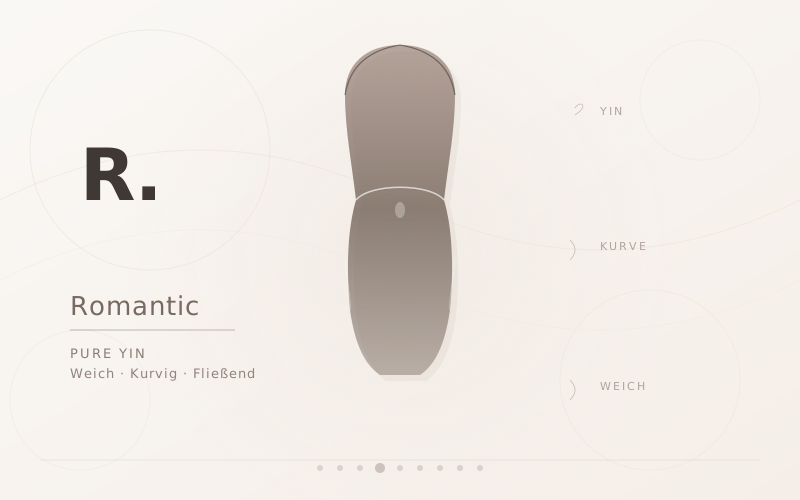
10. Romantic
The pure Yin line. Small to medium height, short bones, lush curves, a full face, soft presence. Everything is rounded, nothing angular. Romantics need clothing that embraces their curves rather than hiding them: fitted waists, flowing skirts, soft fabrics, delicate prints. The classic mistake: boxy blazers and straight trousers that make Romantics look like they're wearing a costume. Icons: Marilyn Monroe, Scarlett Johansson.
11. Soft Classic
Balanced Yin-Yang with a touch more Yin. Medium height, harmonious proportions, a soft face, gentle curves. Soft Classics are what used to be called "elegant": flowing, feminine, timeless cuts — wrap blouses, cashmere, soft A-lines. Icons: Grace Kelly, Kate Middleton.
12. Classic
This type is also no longer independent in Kibbe's updated classification. It described the perfect balance — but Kibbe himself later explained that true symmetry is extremely rare in reality and most "Classics" are actually Soft Classics or Dramatic Classics.
13. Dramatic Classic
Balanced Yin-Yang with a touch more Yang. Medium to tall height, harmonious but slightly severe proportions, defined bones, clear facial features. Dramatic Classics need structured, clean, minimalist cuts: shouldered blazers, straight skirts, crisp lines. Too much softness makes them disappear. Icons: Jackie Kennedy, Diane Sawyer.
Why Almost All Online Kibbe Tests Get It Wrong
If you're reading this article, you've probably already taken one of those free Kibbe tests online. You answered a few questions — "Are your shoulders more sharp or soft?" — and an algorithm assigned you a type. Then you read the description and thought: "Hmm. Sort of. But not quite."
That's no coincidence. Online tests, in my experience, are wrong in roughly 7 out of 10 cases. There are three reasons for this:
- Self-perception is unreliable. Most women do not see their own body objectively. Someone who has been told for years that she has "broad shoulders" will tick "broad" even when her shoulders are actually narrow. Kibbe analysis requires a neutral eye.
- Individual features lie. Your Kibbe type emerges from the total combination, not from isolated features. One sharp shoulder alone does not make you a Dramatic. Only when you read it together with height, facial features, proportions and bone structure does a picture form.
- Many quizzes use outdated categories. As you saw above, Natural, Gamine and Classic no longer exist as standalone types in the current Kibbe system. Tests that assign you these results are working with outdated data.
That doesn't mean these quizzes are useless. They are a first impulse. But they are no substitute for a genuine analysis.
How Do You Find Your Real Type?
If you're serious about it, there are three routes:
1. The photo method (free, but imprecise). Photograph yourself in fitted, neutral clothing: straight from the front, from the side, from behind. Face separately. Then compare your silhouette with the 13 types systematically. This method works for about 30% of women — the other 70% see themselves too distortedly.
2. The community method. In Reddit forums and Facebook groups you can post your photos and get an assessment from other enthusiasts. The problem: the quality of answers varies enormously, and often a type carousel develops where after three months you still don't know whether you're Soft Natural or Soft Classic.
3. The professional analysis. A trained Kibbe consultant looks at you — live or via high-resolution photos — and makes a decision grounded in hundreds or thousands of comparisons. She sees things you cannot see yourself: how your bones drape fabric, how your face communicates with your proportions, where your visual centre sits. That is the difference between "I think I'm a Romantic" and "I know I'm a Romantic — and now I also understand why my favourite blazer doesn't work."
Kibbe Is Not the Same as "Apple, Pear, Hourglass"
One of the most common questions in my consultations: "Isn't this just another way of describing body shape?" No. And this distinction matters.
The classical body shape approach (apple, pear, hourglass, rectangle, inverted triangle) describes only the distribution of weight and circumference. It says nothing about bones, height, facial features, proportions or presence. Two women can both be "hourglass" and yet have completely different Kibbe types — one Soft Dramatic, the other Theatrical Romantic. Their body shape is similar. Their style geometry is not.
Body shape asks: "Where is your volume?" Kibbe asks: "What line are you?" That is an entirely different dimension. That is why purely shape-based styling can fail completely, even when it is "technically correct" — because it ignores the line.
What Kibbe Actually Gives You
When you know your Kibbe type — the right one, verified — your relationship with shopping changes. Radically.
- You make decisions in seconds. Where you used to bring ten things into the fitting room, you know in advance which three even have a chance. Impulse purchases disappear.
- Your wardrobe shrinks — and yet looks richer. When everything aligns with your line, suddenly everything works together. You need fewer pieces because each one does its job.
- You stop apologising for yourself. This is perhaps the most important point. Many women think an outfit looks strange because something is wrong with their body. Kibbe proves the opposite: your body is not the problem. The cut was wrong for your line. Full stop.
- Trends lose their power. When the oversized blazer is everywhere but you know your Dramatic Classic line needs clean shoulders, you simply walk past it. No guilt. No FOMO.
Frequently Asked Questions
Can my Kibbe type change over the course of my life?
No. Your bone structure, proportions and facial architecture remain. What changes is weight — and with it the degree to which your curves amplify or soften your type. But you won't go from Dramatic to Romantic overnight. Your type is for life.
What if I recognise myself in two types?
This happens often — and is almost always a sign that you haven't found your true type yet. Kibbe is not a blend; you are not "50% Natural, 50% Romantic." You are one type. If you are wavering between two, you have probably misread one of them.
Does Kibbe work if I am very slim or very curvy?
Yes. The system is independent of weight. A very slim woman can be Romantic if her bones are short and her facial features soft. A very curvy woman can be Dramatic if her underlying structure is long and angular. Weight changes the surface, not the line beneath it.
Do I need Kibbe at all if I already have a good instinct for fashion?
Honest answer: if you have known for years what suits you and your wardrobe works, you don't need a type name. But most women who come to me do not have that. They have wardrobes full of clothes that looked great in the shop and wrong at home. For those women, Kibbe is not a pastime — it is the shortest path to peace.
The Next Step
This article was an overview. If you finish it feeling "Now I finally understand what this is — but I still don't know who I am," you are exactly where most women are at this point. It is the normal starting point.
At the JO-Style atelier I offer two routes: a quick, free initial consultation by video where we look together at whether a full Kibbe analysis makes sense for you — and the complete Image Identity consultation, where we not only determine your type but translate it into concrete outfits, shopping lists and a wardrobe that is finally yours. You'll find both options at the bottom of the homepage.
And if you just want to take a look first: on my Instagram channel @jola.deja you'll find real examples from ongoing consultations — including the two reels you can also see at the bottom of the homepage. There you can see what a Kibbe analysis looks like in real life, not just in theory.
Your body tells its own story. The question is simply whether you are ready to learn how to read it.
Further Reading
Which Kibbe type are you really?
Take the interactive test or have Jola determine your type professionally.